| SYMPOSIUM BEIJING |
|
| |
| Field of Vision |
| |
| Transcript of presentation delivered
by Michael Wright |
| |
 |
| |
| These are very simple diagrams and
their intention is to provoke rather than to explain, to provoke a questioning
response from you the audience. |
| |
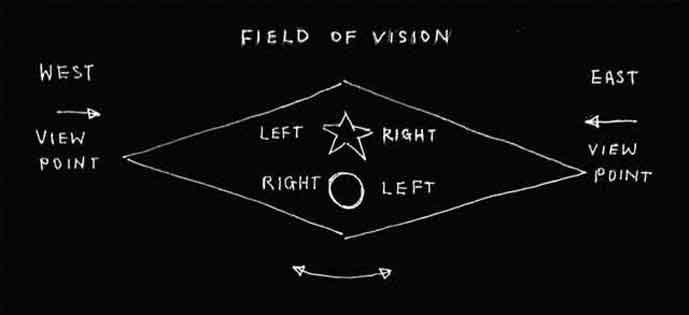
| The essential concept of the Field
of Vision has its roots in a diagram drawn by the projects instigator, Stephan
Hausmeister, which was derived from the philosopher Wittgenstein, which
articulates the relativity of vision… that the perception of relationships
in our field of vision is completely determined by ‘location’. The Artists
contributing to the project understand and work from this concept. From
Wittgenstein’s model you have a point of view, from one perspective a star
is perceived to be on the left and a circle on the right. If you move your
position and view this arrangement from the other side the star and the
circle are still in the same relation but your perception of their relationship
has changed, it is reversed, the star is perceived to be on the right and
the circle on the left. This is really a model of the subjective, ‘qualitative’
nature of how we experience relationships rather than solely a quantitative
assessment of fact. |
| |
 |
| |
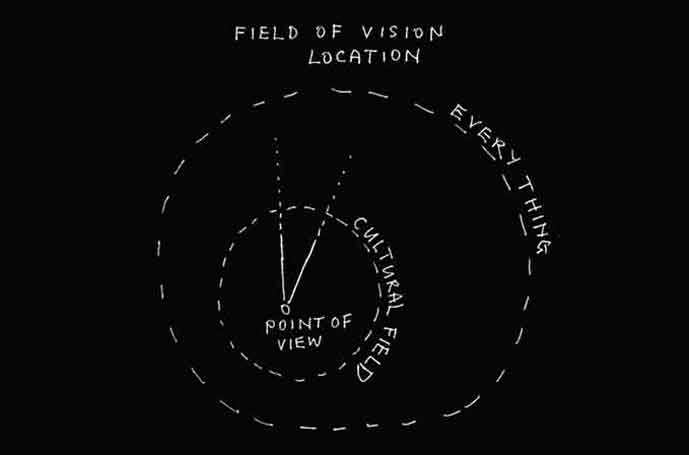
| In this diagram if one thinks of ones
view of the world as being based in a physical location we have a point
of view and this point of view does not sit in a neutral space but in a
cultural narrative. We view the world through narrative structures. What
we see or don’t see is the result of viewing the world through the filter
mechanism of the narratives, which have been constructed for us, narratives
which we inhabit and which inhabit us. The individuals’ subjective view
of the word is really through the construct of a cultural field.
We view everything both within and outside of our cultural field
through the construct of the narrative that we inhabit, so that as we look
out from our point of location everything perceived is filtered through
the cultural field we are located in. |
| |
 |
| |
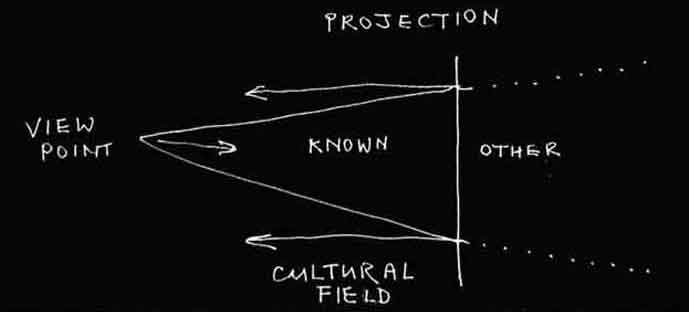
| The idea of who owns, who generates
the narrative is a massively important issue. Narratives define the way
we see the world. Who produces those narratives? Television, producers,
artists, historians, writers, journalists, politicians, Advertisers, they
construct the narratives by which we make sense of the world. |
| |
| Artists of a critical persuasion have
been and are in a position of trying to re-see the narratives, using their
own subjective experience, and examining other peoples experience to re-see
and reshape, to modify or challenge existing or prevailing narrative structures.
The most radical thing the artist does is not to work with old imbedded
narrative structures, but to work with what is emergent, that’s our job,
I think, collectively that we visualise what is emergent now, and this always
needs new strategies. |
| |
| Artists work with the available technology.
Marshal McLuhan stated that the technology creates the language of a culture.
We now have the Internet which gives us another language another
way of making sense of the here and the now. Artist are working with the
internet not for it’s novelty but because it gives us another model, another
way of visualising the here and the now, the emergent. |
| |
 |
| |
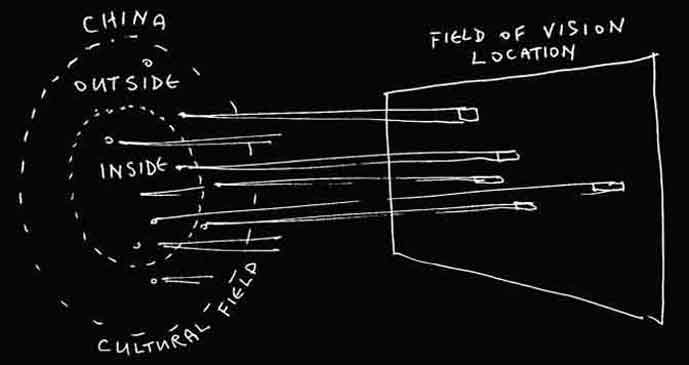
| This is a simplified diagram of what
is taking place in the physical construction of the Field-of-vision. The
Field-of-vision is constructed from lots of different individual stories,
individual visions which have been projected onto this field here. Views
of China from the outside and China from the inside are juxtaposed and viewed
together. |
| |
| The radical element in the Field-of-vision
is that it brings together many different visions that a curator would not
normally bring together. Curators and artists usually try to create a unifying
vision, a unifying idea which binds and gives aesthetic and conceptual coherence,
effectively turning the vision into a product. The process is highly selective
and generally exclusive. This doesn’t happen in the field. The Field-of-vision
is an attempt at a democratisation, a way of trying to visualise a wider
picture, a more democratic picture of what is going on, of what is emerging
now. |
| |
 |
| |
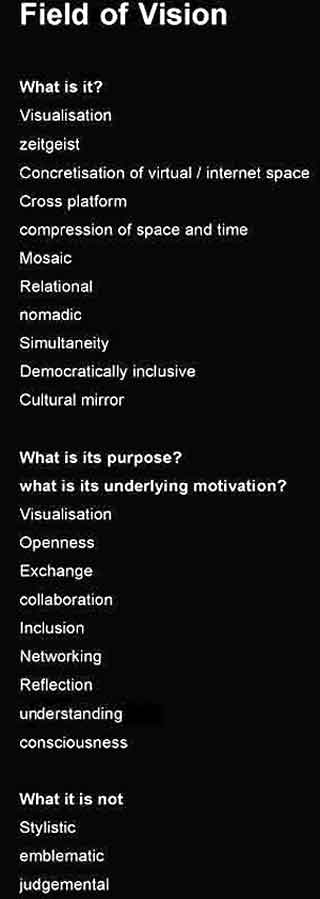
| It is important to know that these
images in the field, once they are transposed onto the internet. are accompanied
with a textual narrative which the viewer will be able to lock onto when
they click on an image, so it is not just a field of images for the eyes,
it is also a field of narratives, of visions, a way of seeing hidden narratives.
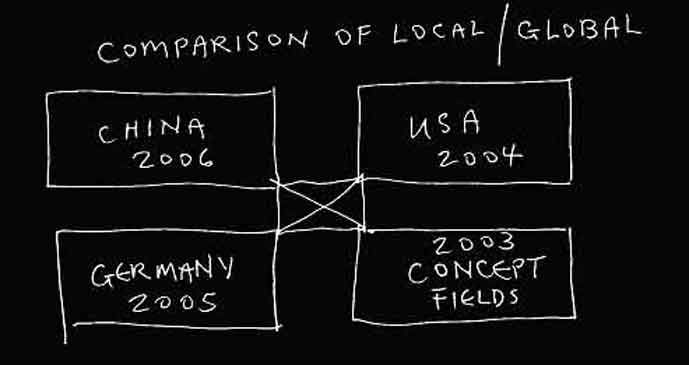
The interesting aspect of the field will be how it exists on the internet
in a way which will allow a comparison of the various fields constructed
to date in China, New York, Germany. The possible permutations of correspondences
will be the real life of the fields. |
| |
 |
| |
| This draws up issues of globalisation.
Visiting Documenta 11 in 2002 a major issue that was highlighted thematically
was the relationship between globalisation, networking, and the role of
the artist in creating alternative models of art production, other than
producing art for an international market. The international market is controlled
largely through the dominance of commercial centres, whose vested interest
is in the promotion of its own power and status, which inexorably subsumes
the artist’s narratives within their given cultural and commercial value
system and accompanying narratives. |
| |
 |
| |
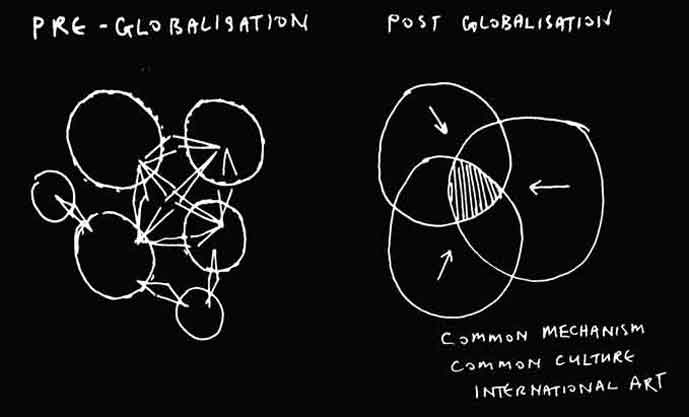
| Pre-globalisation, colonial models
dominated the world, based on the relationship between distinct cultural
fields, China, America, Europe, Asia, East, West, Soviet block etc. and
these would be in tension with each other, competing borrowing or colonising.
The model that is emerging under the prevalence of globalisation is that
these cultural fields are perceived to have an increasing overlap… merging
together. This points to the idea of an increasing common culture of a shared
technology, of sharing the same common narrative. It was predicted in the
1980s that, with the demise of Communism and the ascendancy of global capitalism,
the only common cultural narrative which would exist for the world would
be consumerism. |
| |
| Our perceptions are oriented to a
habitual binary model of opposites, and this equally applies to our relationship
to cultural narrative, a positive defined by its negative. This binary model
was enacted through the Cold war through negative projection from both sides,
which defined the good in ones own culture by its bad opposite. The binary
narrative of fear of ones perceived cultural opposite served the political
purpose of creating cultural cohesion and collective sense of purpose. This
binary model persists, refocusing on new perceived threats, with the demise
of the soviet block as the primary threat, post 9/11 the focus has shifted
to ‘Axis of Evil’ and a new model of the necessary projection of fear has
reformed to ‘War on Terror’. |
| |
| Artist have had a major role in relation
to undermining binary models by persistently transgress boundaries, by enacting
a process of de-differentiation, enacting flux of concept and material,
fulfilling a role of mediating or moving between different domains, physical
and perceptual, concrete, conceptual, psychological, emotional and political,
moving across boundaries and most importantly across cultural boundaries
which are simplistically characterised as opposites by the application of
the binary model. |
| |
 |
| |
| The old colonial model was of communication
from the centre, the abstract, absolute, universal and divine, channelled
through the centre of power as the axis of cultural and political energy
epitomised by the Emperors chair, (emulated by Mao). All the cultural energy
was channelled through the centre and disseminated to the periphery. |
| |
| It can be perceived that the people
who control the media also have a common agenda of generating narratives
from the centre of commercial and political power. It is their narrative
which is disseminated to the physical and cultural periphery. In the Documenta
11 alternatives to this essentially neo-colonial model were highlighted
and in particular models of regional localised production, functioning to
visualise localised narratives. The decentred model has partially existed
through regional arts programmes and institutional arts structures which
have an uneasy relationship to and challenge the values of the market. Instead
of being bound to the flow of international market forces the alternative
paradigm is localised centres of artistic activity connected and communicating
with each other. The regional arts model has politically still to account
back to the centre for its arts funding, however the internet allows for
a more radical decentred level of production, a model without a controlling
centre. It is a challenging model, a model we are not used to, this model
has a visual correspondence in the aims of the Field of vision project. |
| |
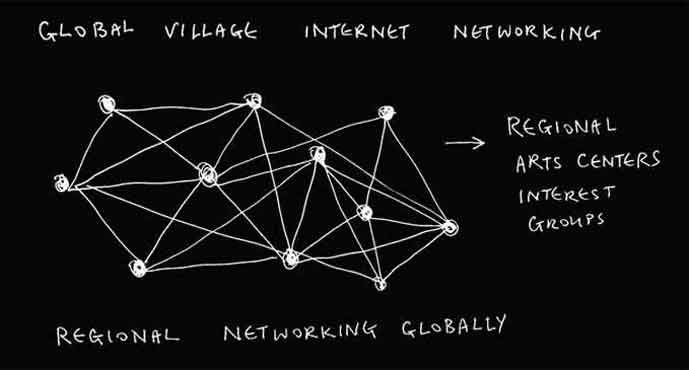
| The Internet as a network, the technology
allows us to move away from the centre and still have a network of related
and unrelated communities in conversation. This model, prior to the internet,
paradoxically, was a characteristic of the urban environment, the city being
many networks in close physical proximity. However people who were not based
in the urban environment were in principle subject to the influence of these
urban networks as power and culture are disseminated outwards. Regional
artists could not successfully participate without migrating to and competing
at the centre. On this principle the industrialisation of society has been
one of increasing urbanisation, of migration to the centre to access these
economic and cultural networks. With
the advent of the Internet cultural production can more readily function
outside of the city and still be connected, potentially allowing for a reversal
of the flow to the urban centre, at least from the perspective of art production. |
| |
| This potential de-centred networked
model of culture has massive implication for the potential generation and
understanding of narrative in the arts. There is now a potentiality of a
culture constructed from a plurality of narratives, displaced by space but
potentially connected and networking in potential simultaneity and plurality.
The internet has the potential, as a technological and cultural structure,
to both generate and hold a complexity of cultural dialogue, operating as
an alternative to the narratives generated from the cultural centre; centres
whose tendency is towards homogeneity of narrative rather than plurality,
hierarchical, competitive and exclusively product oriented rather than attentive
and inclusive of regional and local narrative. |
| |
 |
| |
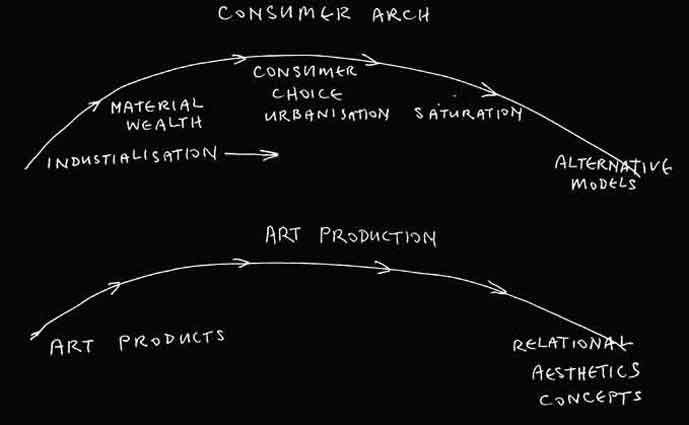
| The Consumer Thesis: The process of industrialisation and globalisation
generates a welcome expansion of consumer choice, wealth is generated, and
if not through enlightened democratic governmental control, in the form
of equitable taxation and governmental intervention, by a process of ‘trickle
down’ a society develops collective wealth and opportunity. This is the
Capitalist thesis, the belief in ‘progress
through globalisation’ which is promoted as the sole model which will liberate
all cultures into the ‘freedom’ and happiness of consumer choice and democratic
governance, a new global creed to replace the failed project of socialism. |
| |
 |
| |
| The thesis continues….Inexorably consumerism
will reform closed political systems, undermining their power base through
the power of global patterns of consumerism, promoted by the free market
economy and enforced trade agreements, in which corporate companies (who
are subject to little or no accountability) distribute worldwide. On this
model ‘freedom’ is exported world wide and reactionary governments forced
to subsume the consumer model. Consumerism is based on competition and choice
and the best will ascend through the application of consumer choice, every
child in the world will have access to Homer Simpson, the supermarket, Walt
Disney and appropriate the narratives of consumer culture. |
| |
| The most optimistic model is of a
global culture absorbed and running alongside a local culture in which a
community has a commonality with other global communities, sharing a common
information technology and narratives while maintaining its own localised
cultural idiosyncrasies and specific regional identity. While this can be
observed as occurring for certain sections of urban communities world wide,
in reality, for those who are marginalised from the centres of power and
who actually produce the commodities, this model is not experienced as liberating
but exploitative, inequitable and unsustainable. Consumerism, it seems is
dependent of persistent forms of exploitation of the weakest members in
the global community, unaccountable shareholders and corporate management
determine the limits of their lives in pursuit of competitive products for
the consumer market. |
| |
| It is disingenuous to criticise a
model of consumerism from the privileged position of being a comfortable
consumer and further indefensible to criticise others in pursuit of the
same privileges when it will mean potential escape from degrees of drudgery
unimaginable to present day western consumers. There is an inexorable momentum
towards urban industrialisation taking place world wide and most dramatically
in India and China, the factories of the world. The presumption is that
the wealth generated will generate better conditions for many. |
| |
| In the West the momentum of industrialisation
has passed its zenith into a culture of service and ‘creative’ industries.
Society is now accompanied by degrees of anxiety incommensurate with
the privilege and comfort enjoyed by the majority. Depression afflicting
one in six. The presumption is an increasing disillusionment as social problems
of failing citizenship and social cohesion appear to be under threat from
40 years of unbridled consumerism. The primary critique of Consumerism is
that this social model generates and functions on a permanent state of dissatisfaction,
based on a permanent sense
of ‘lack’. Consumerism has an in built requirement for discontent which
promotes unrealistic levels of consumption in the search for happiness.
This in turn generates an aggressive competitive rather than a cooperative
cultural mind set. This negative aspect of consumerism is
destabilising, generating delusory levels of dysfunction in the form of
unrealistic aspirations, (the cult of celebrity) dependency on entertainment
as a staple and inexorably anxiety as citizens are reduced to spectators.
There is in the consumer model a form of barbarism, consuming without understanding
or accountability, in a state of anxiety generated by the fear of potential
loss and the unrequited sense of longing unfulfilled. |
| |
| While some communities are gaining
from globalisation in reality
the divides between rich and poor are increasing rather than diminishing,
fuelling a reactionary cultural backlash towards western culture in the
form of fundamentalism and in extremity generating terrorism. The perilous
ecological threats from unbridled consumerism, fostered through the globalisation
model are becoming clear and the political and social tension generated
by inequitable access to supply are increasing rather than diminishing political
instability. |
| |
| It is inevitable that the critical
intellectual and cultural dialogue has turned to an examination of this
ascending consumer model and a preoccupation with re-examining and articulating
alternative cultural models. Recent movements in the arts are refocusing
on relationship and the significant role of the artist redefined, not as
producers of artefacts for the market, but as facilitators of perception.
By focussing on the relationships present in the world, as experienced locally,
the arts are drawn to practices of intervention, redefining an aesthetic
outcome as a means of generating a shift in consciousness, a shift of relationship
(Relational Aesthetics). |
| |
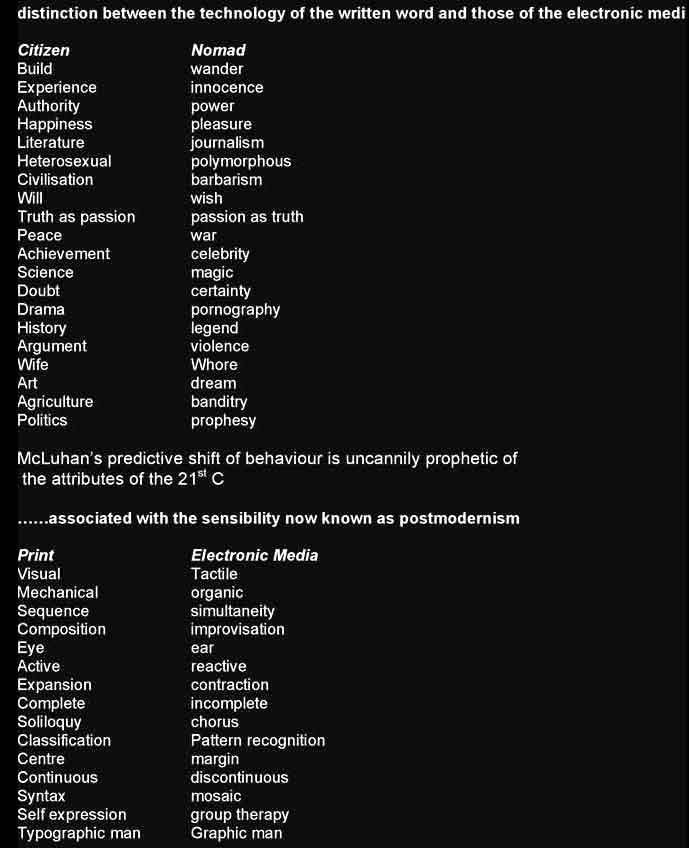
| In the sixties Marshal McLuhan predicted
certain accompanying cultural shifts that would emanate from the expansion
of the media industry. What follows are a set of binary shifts from a literary
culture and technology to a film digital media technology/culture. |
| |
 |
| |
| It is a given that ‘we’ that is the
‘haves’, the consumers, rather than the have nots now inhabit a global culture
constructed from a homogeneity of consumer narrative structures. The media
industry has a symbiotic relationship to markets and the flow of capital,
both following and promoting, overtly through advertising and implicitly
in the value systems embedded in documentary and entertainment forms of
mass communication. Political models equally follow consumer models using
consumer models of branding, attempting to gage and mirror back the expectations
of the consumer, spin replacing polemical dialogue. Sound bites, advertising,
jingles, theme tunes, hackneyed film and documentary narratives, inhabit
our interior space. Fictions have replaced histories with consumer ideals
indoctrinated through incessant repetition. Identities defined by consumption
patterns. The consumer narratives form the cultural landscape which we inhabit
and more insidiously which inhabits us, flooding the imaginative space of
our personal and collective interior. It is impossible to communicate meaningfully
without referencing these narratives as they are imbedded in the very physical
surfaces, social, language and visual cultural fabric. In this respect one
is forced to communicate in relation to, that is in compliance with or in
reaction to these given collective cultural narratives. |
| |
| In the interest of maintaining a necessary
sense of novelty the media industry constantly seeks new forms for the same
structural message. The same binary narratives of the hero and the anti-hero
find new permutations for the same essential plot. Consumerism runs on the
appearance of generating apparently new forms but in reality reiterates
the same familiar and reassuring pattern of unreflective consumption and
easy prejudice. In this sense popular press and entertainment draw the consumer
into a sense of curiosity, shock/horror headline, only to repeat the same
structure which reassures in its utter fixity of formula… novelty without
change. It is essentially a market force which runs on the engine of unreflective
desire, consumption without accountability, enactment without consequence
and inevitably into escapism accompanied by alienation.
In this respect it becomes a cultural imperative to subvert the conventions
of narrative. |
| |
| The response to consumer culture has
been a rear guard action of attempting to assert phenomenological and social
reality, by subverting the normative state of passive acceptance of given
narrative structures. |
| |
| A deal of contemporary art of significance
is concerned with inversions, utilising either the mirror of excess and
absurdity (Paul McCarthy, Jake and Dinos Chapman, Ofili) or moves in the
opposite direction to reduction… art that reduces art to a hole…an empty
space ( Matta Clark, Turrel, Robert Irwin) or a reflective surface (Richter,
Kapoor). an absence ot things,
an empty space (Martin Creed), a perceived negative….a non event… emptied
space becomes a necessary construct in a world which is so utterly filled
with distracting delusory narrative and arbitrary stimuli. By creating spaces
emptied of either the artist’s or agreed social narratives what is left
for the viewer to contemplate but the stuff of the here and the now of their
own consciousness, present in the actuality of
inhabited time and space. |
| |
| In relation to the dominance of consumer
culture art production becomes bound either to the consumer narrative of
delusion and escapism or forms a counter culture, a ploy to focus the viewers
attention back onto their own expectation and responsibility for their own
consciousness. |
| |
| Aspects of emergent art practices
under the form of relational aesthetic point to a potential form of art
work as a polemical conversation in which aesthetic unity is abandoned in
preference to a visualised dialogue of ideas and conventions, which generate
a potential corresponding dialogue in the mind of the viewer. The work is
not an assertion or an expression of… but a visual paradigm of the contradictory
and conflicting tendencies inherent to sentient thought. The art work both
proffers and contradicts what it appears to state, it is essentially anti
iconic, utilises aesthetics yet is anti aesthetic, anti homogenous, irreductive,
asserting contingency, complexity, tensile and reflective, and in essence
because its form is consciousness, non consumable as commodity. |
| |
| Michael Wright, Beijing, September
2006 |
| |